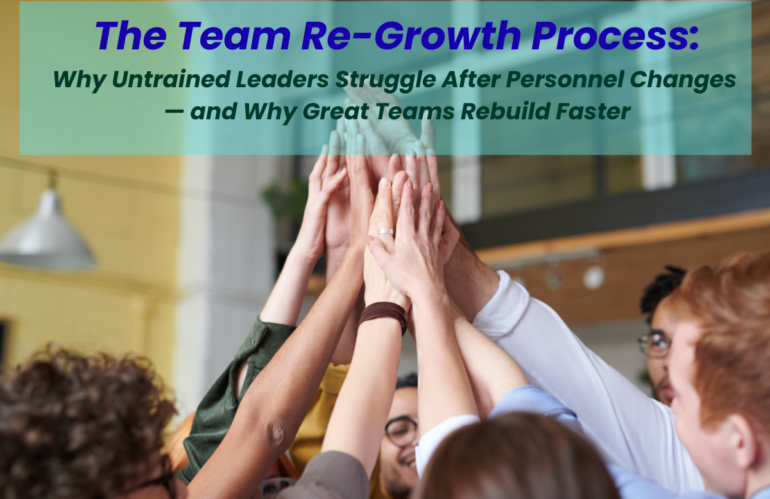
Why Untrained Leaders Struggle After Personnel Changes — and Why Great Teams Rebuild Faster
Most leaders understand the classic stages of team development:
Forming. Storming. Norming. Performing.
What many leaders fail to recognize is this:
Teams do not permanently stay in the “performing” stage.
Every meaningful personnel change causes the team to shift backward developmentally.
- A new hire
- A resignation
- A transfer
- A promotion
- A leadership change
- Rapid growth
- Restructuring
- Layoffs
- Mergers
- Internal role changes
The moment team chemistry changes, the developmental dynamics of the group change with it.
The best leaders understand this.
Untrained leaders ignore it.
And organizations that fail to manage this process often take far longer to regain trust, clarity, cohesion, and high performance.
Team Development Is Not Linear
Bruce Tuckman’s famous team development model introduced the stages:
- Forming
- Storming
- Norming
- Performing
But these stages were never intended to be a one-time organizational milestone.
High-performing teams continually revisit these stages whenever disruption occurs.
The mistake inexperienced leaders make is assuming:
“We already built the culture.”
Culture is not permanent.
Team cohesion is not permanent.
Trust is not permanent.
Every personnel change alters:
- communication patterns
- trust dynamics
- informal leadership
- role clarity
- emotional buy-in
- accountability structures
- and social chemistry
A team may not completely return to “forming,” but it absolutely experiences developmental regression.
I call this:
The Team Re-Growth Process
Championship organizations do not merely onboard people.
They intentionally accelerate team re-growth.
Average organizations simply hope chemistry returns naturally.
Hope is not a strategy.
What Sports Teaches Us About Business Teams
Business teams are not sports teams.
The goals, compensation structures, timelines, emotional dynamics, and performance measurements are different.
But sports provides something uniquely valuable:
a visible, high-pressure laboratory for observing leadership, communication, trust, accountability, emotional resilience, role clarity, and team chemistry in real time.
In athletics, dysfunction becomes visible quickly.
The scoreboard exposes everything.
In business, the same breakdowns often happen more slowly and less visibly:
- communication gaps
- silo thinking
- disengagement
- unclear expectations
- political behavior
- fragmented culture
- declining trust
- and inconsistent accountability
The symptoms may look different.
The underlying team dynamics are remarkably similar.
As a NCAA college coach, I experienced this reality every season.
Every year brought:
- graduating seniors
- freshmen
- transfers
- injuries
- leadership shifts
- role changes
- and evolving team chemistry
Today’s NIL and transfer portal environment has accelerated this instability dramatically.
Programs can no longer assume chemistry will “just happen.”
The teams that rebuild cohesion fastest gain a major competitive advantage.
The exact same principle applies in business.
Great Leaders Understand That Every Team Has Hidden Roles
One of the biggest misconceptions about team building is that success revolves only around star performers.
It does not.
Great teams — in athletics and business — also rely on:
- glue players
- culture champions
- emotional stabilizers
- trusted veterans
- subject matter experts
- pressure performers
- connectors
- accountability leaders
- relationship builders
Some people carry culture.
Some carry trust.
Some carry calm under pressure.
Some carry consistency.
Some carry institutional knowledge.
Some carry empahy
When those individuals leave, organizations often underestimate the impact because their contributions may not appear on a scoreboard, spreadsheet, or performance review.
But internally, the team feels the loss immediately.
Great leaders intentionally develop these hidden leadership roles as part of their culture-building strategy.
Weak leaders accidentally lose them.
Why Green Leaders Struggle With Team Re-Growth
Inexperienced leaders often make one of two critical mistakes after personnel changes.
Mistake #1: Pretending Nothing Changed
They continue operating as if:
- trust still exists at the same level
- communication patterns are intact
- leadership roles remain clear
- team cohesion is unaffected
But internally, the team dynamics have shifted dramatically.
“Trust the process.”
Mistake #2: Forcing Performance Before Rebuilding Alignment
Some leaders become frustrated when performance temporarily declines.
Instead of rebuilding:
- trust
- communication
- role clarity
- emotional buy-in
- accountability
they simply increase pressure.
This often creates:
- disengagement
- frustration
- confusion
- blame
- politics
- turnover
- hidden resentment
Ironically, the harder they push performance prematurely, the longer it often takes the team to stabilize.
Great leaders understand:
You cannot sustainably accelerate performance until you rebuild alignment.
This is one of the hidden meanings behind the phrase:
“Trust the process.”
You hear great coaches say it constantly.
But the best coaches are not talking about blind optimism.
They understand that before high performance can return:
- trust must be rebuilt
- roles must stabilize
- communication must normalize
- leadership must emerge
- team chemistry must re-grow
Performance is often the byproduct of successful re-growth.
Untrained leaders panic during regression.
Experienced leaders understand the process.
That is why leadership development matters.
Modern leadership requires more than operational management.
It requires:
- culture re-stabilization
- trust acceleration
- leadership recalibration
- communication development
- intentional team re-growth
Those are trainable leadership skills.
Organizations that fail to develop them often remain trapped in repeated cycles of dysfunction after every major personnel change.
Great Teams Don’t Just Add Talent — They Rebuild Alignment
One of the most dangerous assumptions leaders make is believing:
“If we add talented people, performance will naturally improve.”
Talent alone does not create cohesion.
Every new member changes:
- communication rhythms
- trust dynamics
- leadership balance
- emotional safety
- role identity
- cultural chemistry
This is why even highly talented teams can temporarily underperform after personnel changes.
Championship-level organizations understand this and proactively rebuild alignment.
They create intentional re-growth systems.
What Intentional Team Re-Growth Looks Like
The best organizations do not leave team cohesion to chance.
They build structured systems to accelerate trust, clarity, accountability, and cultural alignment.
That process often includes:
“He/she that teaches, learns twice.”
Cultural Integration Plans
Not just paperwork and orientation.
Real onboarding into:
- mission
- values
- standards
- communication expectations
- behavioral norms
- team identity
Veteran Leadership Involvement
One major mistake organizations make is isolating onboarding within HR or management.
Elite organizations involve trusted veterans directly in the re-growth process.
Why?
Because culture transfers most effectively peer-to-peer.
Experienced team members can:
- mentor newcomers
- model standards
- teach unwritten expectations
- reinforce accountability
- accelerate trust development
Ironically, onboarding is often tedious for veteran employees.
But the best organizations solve this by giving veterans ownership:
- mentorship responsibilities
- culture ambassador roles
- leadership circles
- onboarding partnerships
- peer coaching
- storytelling opportunities
When veterans teach culture, they deepen their own commitment to it.
There is a great Japanese proverb:
“He/she that teaches, learns twice.”
The act of teaching reinforces standards, deepens ownership, and strengthens cultural identity within the veteran team members themselves.
The best organizations understand this:
Culture becomes stronger when leadership responsibility is shared internally — not centralized exclusively at the top.

Leadership Development Through Teaching
As a NCAA college coach, I often told my players:
“We are explaining why we run this play, strategy, or execution — so that someday, when you are coaching or leading others, you will understand “the why” behind it when you teach it yourself.”
That mindset changes development entirely.
The goal is no longer simply task execution.
The goal becomes leadership development.
Great coaches and organizational leaders understand that every team member already possesses leadership influence at some level:
- through communication
- behavioral modeling
- emotional consistency
- accountability
- mentoring
- cultural reinforcement
The best organizations intentionally cultivate that leadership capacity early.
Why?
The best leaders spend time teaching the “why,” not just the “what.”
Because teaching deepens ownership.
When people understand not only what to do, but why it matters, they begin internalizing:
- standards
- values
- decision-making
- culture itself
This creates something extremely important during periods of team re-growth:
Internal leadership continuity.
When organizations lose veteran employees, senior leaders, experienced managers, or influential team members, the culture becomes vulnerable unless leadership understanding has already been distributed throughout the organization.
Championship cultures are not dependent upon one leader.
They create layers of leadership.
That is why the strongest teams actively involve veterans, culture champions, and emerging leaders in:
- mentoring
- onboarding
- communication
- accountability
- leadership development
This is also why the best leaders spend time teaching the “why,” not just the “what.”
Instruction creates compliance.
Understanding creates ownership.
And ownership creates culture sustainability.
Re-Establishing Team Norms
Strong teams continuously revisit:
- expectations
- communication norms
- conflict resolution
- accountability standards
- role clarity
- leadership responsibilities
- behavioral expectations
High-performing culture requires reinforcement.
Accelerated Relationship Building
Trust does not happen accidentally.
Strong organizations intentionally create:
- collaborative challenges
- communication exercises
- leadership discussions
- shared experiences
- strategic planning sessions
- problem-solving opportunities
The faster relationships develop, the faster performance stabilizes.
Adjustable Leadership Styles
Different stages of team development require different leadership approaches.
Early-stage or disrupted teams often need:
- more structure
- more clarity
- faster feedback
- stronger communication
- greater leadership visibility
- more teaching-oriented leadership
Mature teams require:
- empowerment
- collaboration
- autonomy
- shared ownership
- greater participative leadership
Great leaders recognize the difference.
One of the patterns I have repeatedly observed in both coaching and consulting is this:
Most leaders have one “fallback” leadership style.
Some default toward:
- highly detail-oriented leadership
- hands-on management
- big-picture inspiration
- participative collaboration
- laissez-faire autonomy
But elite leaders adjust their style based on the developmental stage of the team.
New teams and inexperienced team members often require significantly more:
- structure
- teaching
- repetition
- role clarification
- accountability
- skill development
Legendary basketball coach John Wooden famously taught incoming freshmen players how to properly tie their basketball shoes.
At first glance, this seems almost absurdly detailed.
But Wooden understood something profound:
Championship cultures are built intentionally from the ground up.
Early-stage teams often need leaders who are:
- teachers
- detail managers
- culture architects
- and behavioral modelers
As teams mature, leadership must evolve as well.
The mistake inexperienced leaders make is using the same leadership style regardless of the team’s development stage.
Some leaders give too much autonomy too early.
Others continue micromanaging teams that are ready for empowerment.
Both create friction.
The best leaders understand:
Leadership is not static.
Leadership must evolve as the team evolves.
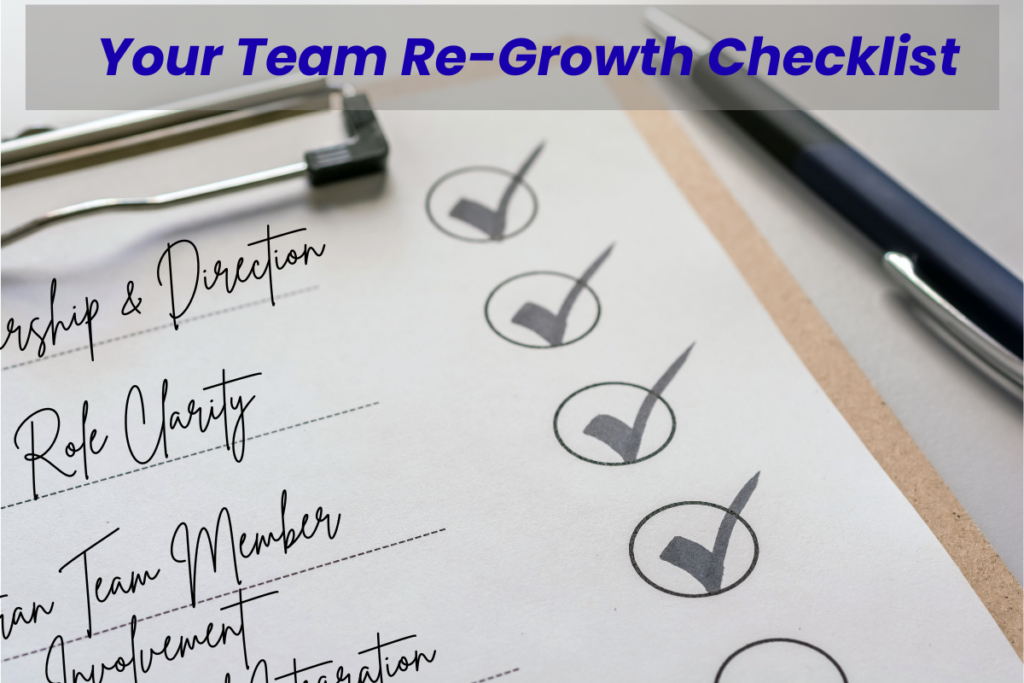
The Team Re-Growth Checklist
When personnel changes happen, great leaders do not simply hope chemistry returns.
They intentionally rebuild alignment, trust, communication, and culture.
Ask yourself:
Leadership & Direction
- Do you have a clear plan for rebuilding team cohesion after personnel changes?
- Have you identified the cultural standards that must be reinforced immediately?
- Do leaders understand that team regression after change is normal?
- Are leadership styles adjusted based on the team’s current development stage?
Cultural Integration
- Do new members clearly understand your mission, vision, and values?
- Are behavioral expectations explicitly communicated?
- Have you clarified communication norms and accountability standards?
- Are unwritten cultural expectations intentionally taught?
Veteran Team Member Involvement
- Are veteran team members involved in onboarding and integration?
- Have you identified your “culture champions” and “glue players”?
- Are experienced team members mentoring newcomers?
- Do veterans help reinforce team identity and standards?
Role Clarity
- Does every team member clearly understand:
- their role
- expectations
- responsibilities
- decision-making authority
- Have role changes been openly discussed with the team?
- Have hidden leadership roles been intentionally reassigned when key people leave?
Relationship Building
- Are there structured opportunities for trust-building and relationship development?
- Does the team engage in meaningful dialogue and collaborative problem solving?
- Have you intentionally accelerated relationship development?
Communication
- Are communication expectations clearly defined?
- Do team members feel psychologically safe speaking up?
- Are difficult conversations addressed quickly and directly?
- Are leaders visibly reinforcing transparency and consistency?
Accountability & Performance
- Have team standards been re-established after personnel changes?
- Is accountability handled consistently?
- Are performance expectations clearly reinforced?
- Are leaders recognizing and rewarding behaviors that strengthen culture?
Adaptability & Monitoring
- Are leaders actively monitoring team chemistry and morale?
- Do you regularly evaluate engagement, trust, and communication?
- Are you proactively addressing signs of fragmentation or disengagement?
- Do you have a strategy for accelerating re-growth during future changes?
The Teams That Re-Grow Fastest Win
Organizations that master team re-growth gain enormous advantages:
- Faster cohesion
- Better communication
- Stronger trust
- Higher engagement
- Reduced conflict
- Better retention
- Greater adaptability
- Faster productivity
- Stronger morale
- More resilient culture
- Better leadership development
- Greater consistency under pressure
Most importantly:
They shorten the time between disruption and high performance.
That is one of the defining leadership challenges of modern organizations.
The future belongs to leaders who understand:
Every team is always either growing, regrowing, or declining.
The question is:
Do you have a Team Re-Growth Process?
Or are you simply hoping chemistry returns on its own?
Leadership Reflection
If your organization is experiencing:
- rapid growth
- turnover
- restructuring
- leadership changes
- onboarding challenges
- disengagement
- declining morale
- communication breakdowns
- or loss of team cohesion
it may not simply be a performance problem.
It may be a Team Re-Growth problem.
The organizations that thrive in today’s environment are not the ones that avoid change.
They are the ones that rebuild alignment, trust, communication, and culture the fastest.
Most organizations experience team regression after personnel changes.
Elite organizations prepare for it.
Green leaders often mistake regression for failure.
Experienced leaders recognize it as a developmental stage requiring recalibration, communication, and intentional leadership.
Because culture does not sustain itself accidentally.
Great teams are built intentionally.
And rebuilt intentionally.
Do you have a Team Re-Growth Process?
Continue Building Your Leadership and Team Culture
If this article resonated with you, these additional resources may help your team strengthen morale, communication, engagement, and leadership effectiveness:
Free Leadership Resources
7 Reasons Your Team Has Lost Motivation
Related Leadership Articles
- Signs of Low Morale at Work
- How to Improve Employee Morale in the Workplace
- The Subtle Signs Your Team Is Losing Energy
- The Real Reason Negativity Spreads So Fast at Work
- Why Storytelling Is Your Most Underrated Leadership Skill
Organizations that intentionally invest in:
- leadership development
- communication
- culture
- onboarding
- and team re-growth
consistently outperform organizations that simply hope chemistry “works itself out.”
Hope is not a strategy.
Leadership is.
About Vilis Ozols
Vilis Ozols, MBA is a leadership speaker, NCAA coach, and organizational culture consultant who helps teams improve communication, morale, leadership, and performance.
Contact Us
Email: vilis@ozols.com
Phone: (307) 460-8583
Free Leadership Resources
7 Reasons Your Team Has Lost Motivation
Team Performance Checklist
Because high-performing teams do not happen accidentally.
They are built intentionally.
And rebuilt intentionally.